Eduard/ founder Eduardo Molina returns to the continent he comes from — and explains why the Andes may be the most exciting frontier in tea today.
I grew up with a mountain range in the window.
In Chile, the Andes are not a place you travel to. They are simply there: a wall of rock and snow at the end of the street, the thing you orient yourself by when you walk out of the house in the morning. As a child, I didn't find that remarkable. It was just the shape of the sky. You only understand what you had once you leave.
Berlin, my home for many years now, is beautifully flat. I love this city, but I have never stopped missing the horizon I was born with. When I travelled to the Eastern Himalayas for our first collection, what struck me was not how foreign it felt. It was how familiar. Different mountains, taller mountains, another hemisphere entirely — and still, that same sense of direction that mountains give to people who grew up among them.
So it would be easy to tell you that Eduard/Andes is a homecoming. It is, a little. But if that were the whole reason, it would be a rather small one, and you would be right to be sceptical of it. The truth is that the Andes earned their place in this collection long before I noticed they were also mine.

Tea is much larger than its famous names
More than seventy countries in the world grow tea. Seventy. And yet almost every conversation about fine tea circles the same four or five: China, Japan, India, Taiwan, perhaps Sri Lanka.
There is a good reason for that. Those regions have spent centuries refining what they do, and I have enormous respect for them. I have learned most of what I know from their craft. But there is a risk in only ever returning to the places that already have guidebooks — you end up seeing only what the guidebook already described.
When I started Eduard/, I wanted the label to work like a series of journeys rather than a catalogue. One region per collection. A bridge into a landscape, its people, its terroir. And privately, I made myself a rule: go where the map is still being drawn. Not for novelty — novelty wears off in one cup — but because some of the most interesting tea in the world right now is being made in places that have not yet been given permission to be taken seriously.
The Andes are the clearest example I know.
Why the Andes
Look at the two ranges side by side and the parallel is almost too neat.
The Andes run nearly 9,000 kilometres down the western edge of South America, through seven countries, from Caribbean heat to Patagonian ice. They are the longest continental mountain range on Earth, and in average elevation they are second only to the Himalayas. Aconcagua, at just under 7,000 metres, is the highest peak anywhere outside Asia.

By any measure that tea people usually care about — altitude, cool nights, mist, mineral soils, dramatic changes in temperature between afternoon and dawn — this should be a legendary tea landscape. And in the tea world, it barely registers.
That gap is not a judgement on the tea. It is an accident of history.
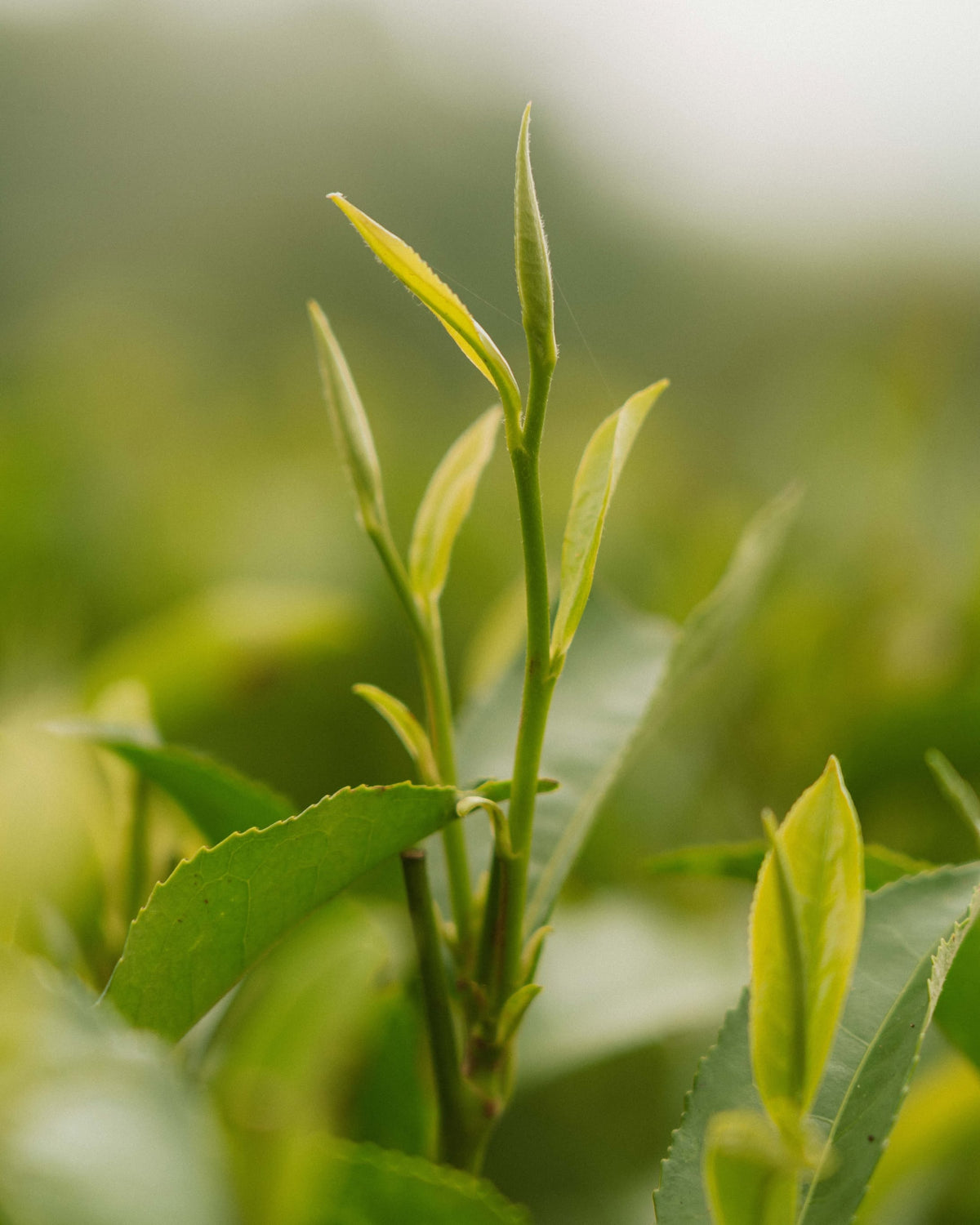
Because the conditions themselves are extraordinary. What altitude does to a tea plant is not complicated, but it is decisive: the higher and cooler the garden, the slower the leaf grows. A leaf that takes its time develops differently from a leaf that races. It accumulates more of the compounds we taste as sweetness, aroma and depth, and it produces less of the flat, rushed character you find in lowland tea grown for volume. Slow growth is the single most reliable predictor of complexity in a cup.
It is precisely why the Himalayan gardens produce what they do. The same physics applies in Colombia and Peru. Nobody has simply been paying attention.
Terroir does not wait for anyone to name it. It is already there, in the cloud forest and the thin air, whether or not the tea world has got around to noticing.

Two gardens, two very different stories
Eduard/Andes comes from two places, and each of them deserves its own story – so we will tell them properly over the coming weeks.
Bitaco, in Colombia's Valle del Cauca, sits between 1,700 and 2,050 metres in the San Antonio cloud forest, almost on the equator. More than half of the land is left as forest, and the plants grow all year round.
Madre Térra, in the Valle de Huyro near Cusco, harvests from tea bushes planted more than a century ago, when Peru briefly had a tea industry of its own. The industry disappeared. The plants stayed.

Most of us encounter a tea region long after the world has agreed it is important. The prices are set, the hierarchy is fixed, the story has been told. It is rare to arrive at the beginning of a chapter instead of the end of one.
With the Andes, we still can.
An invitation
Eduard/Andes brings together five teas from those two gardens, in two countries, along a journey through colour and oxidation — from a bright, tropical green through white and wulong to black, and finally to something that could only come from Colombia: tea and coffee in the same cup.

South American tea has almost never travelled beyond its own continent. That is the whole point. Come and taste a place before the world decides what it is supposed to be.
With love from Berlin,
Eduardo